
🏆 MediaRank Swiss National News: Facebook 2026
Our 2026 Swiss Facebook rankings show which national news publishers are driving engagement. The data reveals clear winners, laggards and wider trends in social performance.

The latest 2026 data for the Swiss media landscape highlights a significant divergence in how successful national publishers are at maintaining their relevance on Facebook. As the platform shifts further toward a community-centric model, Swiss newsrooms are finding that traditional reach is no longer a reliable predictor of actual influence.
The Landscape: Navigating Switzerland's Multi-Core Digital Market
Digital news in Switzerland remains uniquely decentralized, shaped heavily by linguistic borders and high levels of regional loyalty. While the French- and German-speaking cantons exhibit different habits, a common thread that has emerged in 2026 is that the engagement floor has risen.
Facebook continues to hold the largest share of the 35+ demographic, but it has become an increasingly difficult environment for publishers. It is no longer enough to simply syndicate headlines; the brands currently winning are those treating the platform as a hub for conversation rather than a billboard.
Strategic Pivot: From Traffic to Engagement
For years, the industry focused on getting the user off Facebook and onto the publisher’s site. However, the 2026 algorithmic landscape heavily penalizes such overt strategies. Today, the most successful Swiss newsrooms are those mastering native storytelling on the platforms themselves.
The data suggests that interaction is the new currency of survival. In a market like Switzerland, where public trust is high but scrutiny is intense, the ability to foster civil, high-value debate in the comments section is what keeps a brand prioritized in the feed. We are seeing a move away from hard news volume in favor of visual-first, high-sentiment reporting.
Swiss Publisher Performance Audit: 2026 Rankings
Our analysis serves as a comparative benchmark for Switzerland's most prominent news publishers across linguistic borders. By synthesizing raw data—including reactions, dialogue, and shares—we identify which organizations are successfully translating their scale into loyal digital communities.
To measure this, we utilize the engagement rate. This metric reflects the percentage of a publisher’s total following that actively interacts with their content. The engagement rate is calculated by taking the total sum of engagements across all posts, dividing it by the follower count, and then normalizing that figure by the number of days in the study period.
Within the industry, the engagement rate stands as the most representative public-facing benchmark for evaluating how successfully a media brand performs in the social ecosystem.
Below, we present the average engagement rates achieved by the top Swiss publishers as of March 2026.
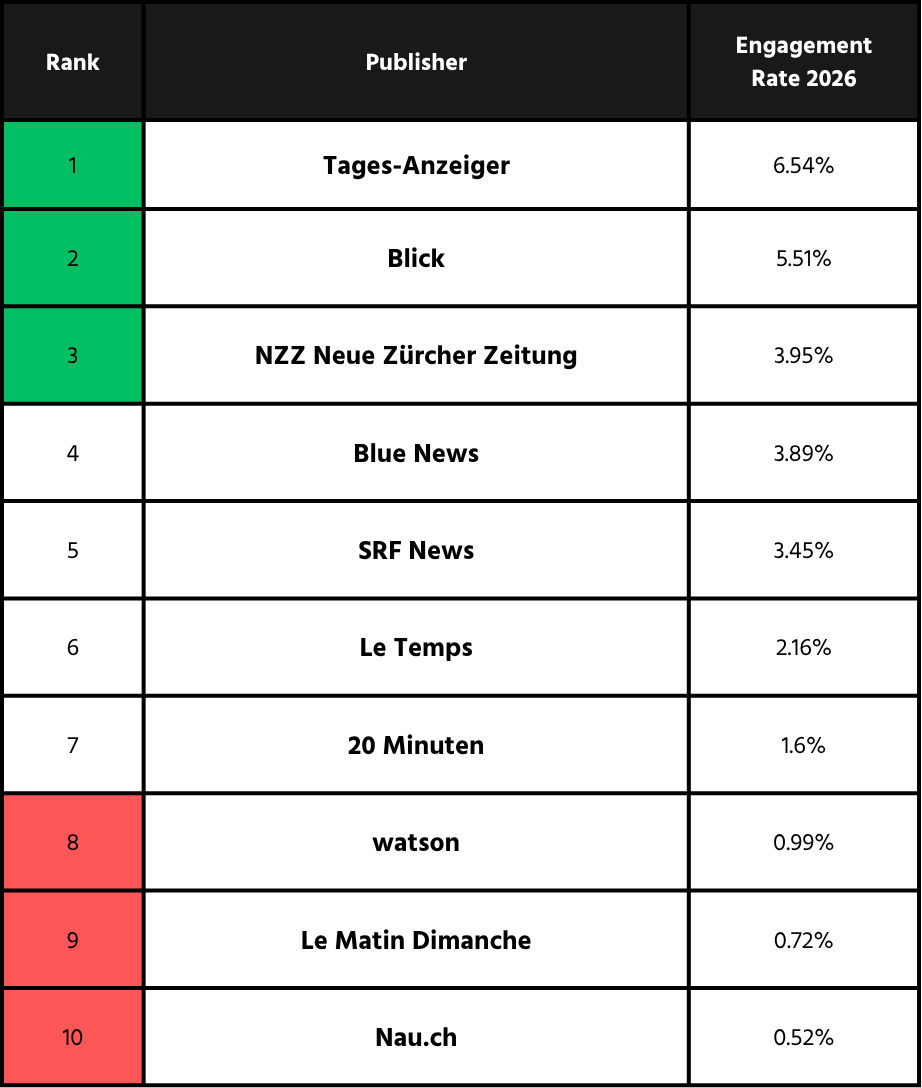
The analysis reveals significant divergences within Swiss media: at the top of the leaderboard, Tages-Anzeiger commands an engagement level that significantly outpaces its closest rivals, maintaining a lead of more than a full percentage point over the next highest publisher. In fact, its engament rate exceeds the combined total of the bottom five outlets in the top ten.
Conversely, at the tail end of the spectrum, Nau.ch recorded the lowest engagement rate of any major Swiss news publisher and trailing significantly behind the next lowest-ranked titles, Le Matin Dimanche and watson.
Next we compared these figures with the average engagement rates achieved in March 2025 and looked at the percentage change between 2025 and 2026.
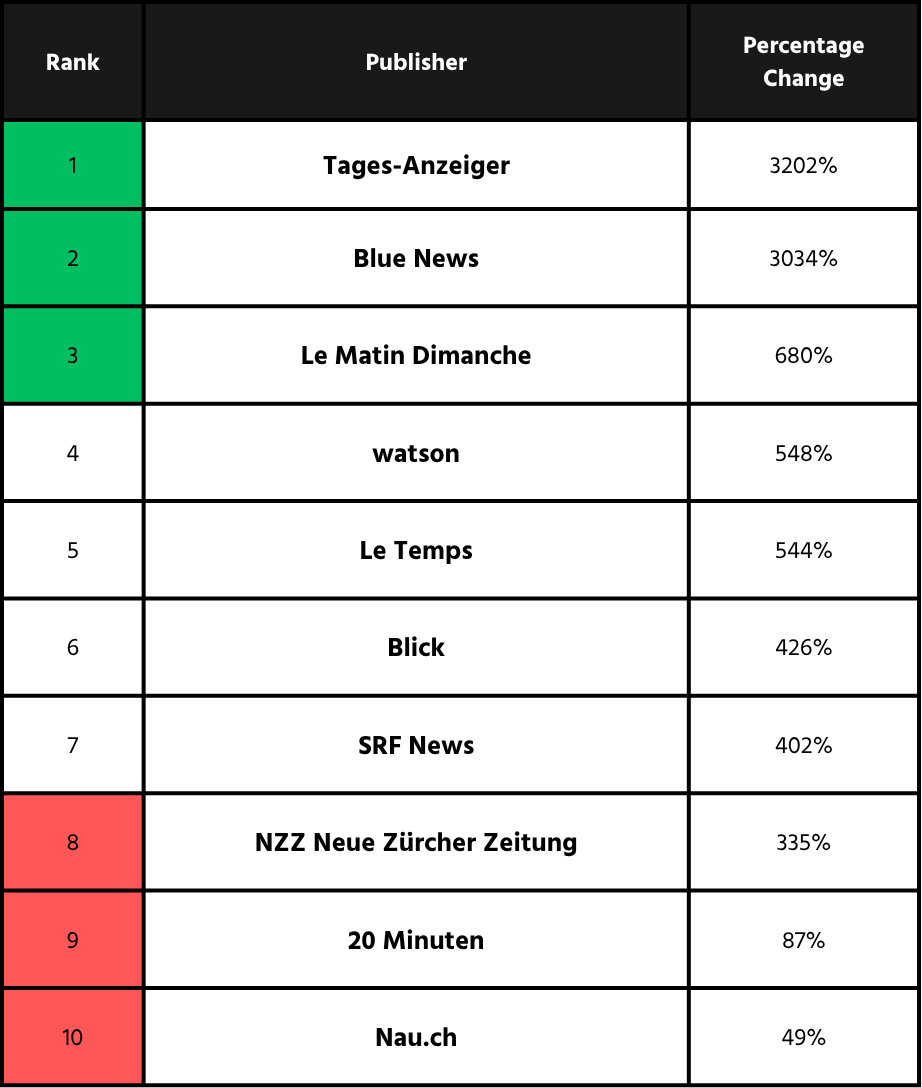
The analysis of year-over-year growth reveals several dramatic outliers: at the absolute peak of the rankings, Tages-Anzeiger again achieved a surge in engagement that dwarfs its competitors, securing a lead of nearly 200 percentage points over the next closest publisher and over 2,500 more than Le Matin Dimanche in third.
Nau.ch recorded the smallest engagement gain, landing at less than one-sixtieth the performance of the market leader and falling significantly behind the next lowest-ranked title, 20 Minuten.